The First computer History
The first computer History
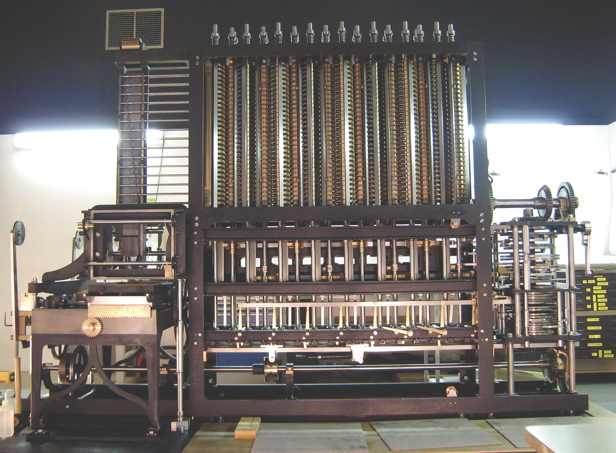 The Difference Engine was the first automatic, mechanical calculator designed by British mathematician Charles Babbage, who proposed its construction in 1822 to the Royal Astronomical Society. He suggested the machine would employ the decimal number system and would be powered by turning a handle, as a method to calculate mathematical tables mechanically, therefore removing the high rate of human error.
At first Babbage received financial backing from the British Government, but this was later pulled when no apparent progress had been made on constructing the device. The inventor went on to design a more general analytical engine and then later in 1847 an improved engine design – the Difference Engine No. 2.From 1989 to 1991, using Babbage’s original plans of this second version, the London Science Museum constructed Babbage’s envisaged machine. Faithful to the original designs the machine consists of over 8,000 parts, weighs five tons and measures 3.4 metres (11 feet) in length. In 2000 the printer which he plotted to accompany the engine was added and together performed as the inventor had intended over a century before. The completion of the machine ended a long-standing debate as to whether Babbage’s designs would’ve worked. 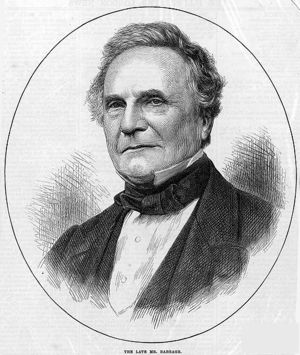 Charles Babbage KH FRS (/ˈbæbɪdʒ/; 26 December 1791 – 18 October 1871) was an English polymath.[1] A mathematician, philosopher, inventor and mechanical engineer, Babbage originated the concept of a digital programmable computer.[2]
Charles Babbage KH FRS (/ˈbæbɪdʒ/; 26 December 1791 – 18 October 1871) was an English polymath.[1] A mathematician, philosopher, inventor and mechanical engineer, Babbage originated the concept of a digital programmable computer.[2]
Considered by some to be a father of the computer,[2][3][4][5] Babbage is credited with inventing the first mechanical computer that eventually led to more complex electronic designs, though all the essential ideas of modern computers are to be found in Babbage's Analytical Engine.[2][6] His varied work in other fields has led him to be described as "pre-eminent" among the many polymaths of his century.[1]
Parts of Babbage's incomplete mechanisms are on display in the Science Museum in London. In 1991, a functioning difference engine was constructed from Babbage's original plans. Built to tolerances achievable in the 19th century, the success of the finished engine indicated that Babbage's machine would have worked.


Comments
Post a Comment